
The America We're Handing Forward
Fifty years ago, during America's Bicentennial, I was about the same age many Gen Z professionals are today—just beginning my career and trying to imagine what the future might hold.
Like so many Americans, I remember the concerts, the parades, the fireworks, and the tall ships. The tall ships especially captured my imagination. They connected us to the earliest chapters of our nation's story while inviting us to imagine what might come next. It felt like the whole country had paused to celebrate where we had been while looking ahead with optimism to where we were going.
What I couldn't imagine was the world we live in today.
Laptop computers. Smartphones. GPS. Artificial intelligence.
If someone had described 2026 to me in 1976, If someone had told me in 1976 where we'd be today, I'd have wondered what episodes of The Jetsons they'd been watching.
This week, as we approach America's 250th birthday, I find myself wondering about another generation.
I wonder what today's young professionals will remember about this moment when they gather to celebrate America's tricentennial in 2076.
None of us can accurately picture the world they'll inherit.
But we are helping to shape it.
Every day seems to bring another headline about artificial intelligence. Depending on who you listen to, it's either the greatest opportunity of our lifetime or an existential threat to the workforce.
I think we may be missing the bigger picture.
Recently, former U.S. Commerce Secretary Gina Raimondo made a compelling point in her TED Talk. She argued that America needs more than a technology strategy. We also need a human capital strategy. If AI transforms work - and it surely will - we have an equal responsibility to prepare people for what comes next.
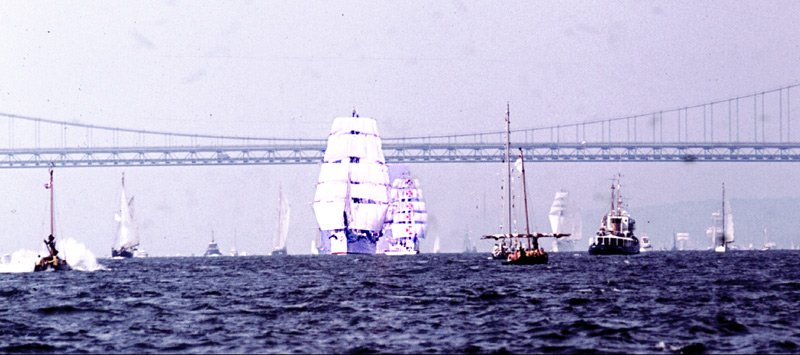
Photos: The Parade of Sails America's Bicentennial celebration, New York Harbor, July 1976. Public domain.
We've lived through transformational change before. The challenge has never been technology itself. The challenge has been whether we're willing to invest in people as thoughtfully as we invest in innovation.
AI isn't waiting for us to feel ready.
Our responsibility is to make sure people don't get left behind.
The more I think about it, the more I realize this isn't simply a technology challenge.
It's a creative challenge.
For the past several weeks I've been wrapping up my Intro to Theatre course. My students have been reflecting on the creative process, and one lesson kept resurfacing.
Creativity isn't magic.
It's not reserved for artists.
And it's certainly not chaos.
Whether we're writing a play, designing a product, leading a team, or reimagining work in the age of AI, creativity follows a recognizable pattern. It begins with an idea, a question, or a problem worth solving. Then comes the hard part—the uncertainty, the experimentation, the revisions, and the persistence required before something meaningful finally begins to take shape.
The creative process isn't random. It gives us a disciplined way to move ideas from inspiration to implementation, from possibility to impact. It's a process we can learn to trust.
That realization gives me hope because it changes the conversation. Instead of asking, "How do we survive AI?" Perhaps we should also be asking, "How do we become better at creating what comes next?"
This is where I believe intergenerational collaboration becomes indispensable.
Younger generations often help us imagine what could be. They are willing to ask, What if?
Older generations contribute something equally important. We've lived through enough change to recognize the pattern. We know that breakthrough almost always arrives after a season of uncertainty and frustration—not before.
Experience doesn't eliminate the struggle. It reminds us not to abandon the process too soon.
Younger generations help us imagine what could be. Older generations help us recognize what it takes to bring those ideas to life. One expands the possibilities. The other helps turn possibility into progress. Together, they create a future neither could build alone.
As we celebrate 250 years as a nation, I hope that's the story we'll be writing. Not one defined by fear of change or by technology alone, but by our willingness to invest in people, learn from one another, and create together.
None of us can imagine what America will look like in 2076. We couldn't have imagined 2026 when we celebrated the Bicentennial in 1976.
But one thing is certain.
The America we hand forward won't be defined only by the technologies we invent.
It will be defined by whether we chose to invest in one another while we invented them.
More soon,
Mary