
The Moment I Found Language for What I Was Seeing
Sometimes the biggest leadership breakthrough isn't a new solution—it's finding the right framework for understanding the problem.
One of the most frustrating experiences for leaders is knowing something is happening on their team but not having language to describe it.
You can see the tension.
You can feel the disconnect.
You know talented people are talking past one another.
But until you have a framework, solving the problem can feel like chasing smoke.
This week marks the fifth anniversary of the publication of Gentelligence by Dr. Megan Gerhardt, and it feels like the perfect time to acknowledge someone who has played a significant role in my own professional journey.
Long before I became a generational consultant, I was a theatre professor teaching Millennials.
Twenty years ago, I found myself fascinated by the ways different generations approached learning, communication, authority, technology, and collaboration. What I observed in the classroom eventually showed up everywhere else—in workplaces, volunteer organizations, families, and communities.
I didn't need research to tell me that generational differences were real.
I saw them every day.
What intrigued me was that these differences weren't necessarily obstacles. In fact, when people took the time to understand and respect one another's perspectives, the results were often remarkably complementary.
As a theatre artist, that's always been my sweet spot.
Theatre is collaborative by nature. No production succeeds because everyone thinks alike. It succeeds because people bring different experiences, talents, perspectives, and skills to a common challenge. The magic often happens in the tension between viewpoints.
I knew what I was seeing.
What I didn't yet have was language for it.
While searching for articles and research that could help me better understand these patterns, I stumbled across an academic article written by Megan Gerhardt.
I remember thinking:
"I need to know her."
When I eventually read Gentelligence, my reaction was immediate.
"Yes. That's it."
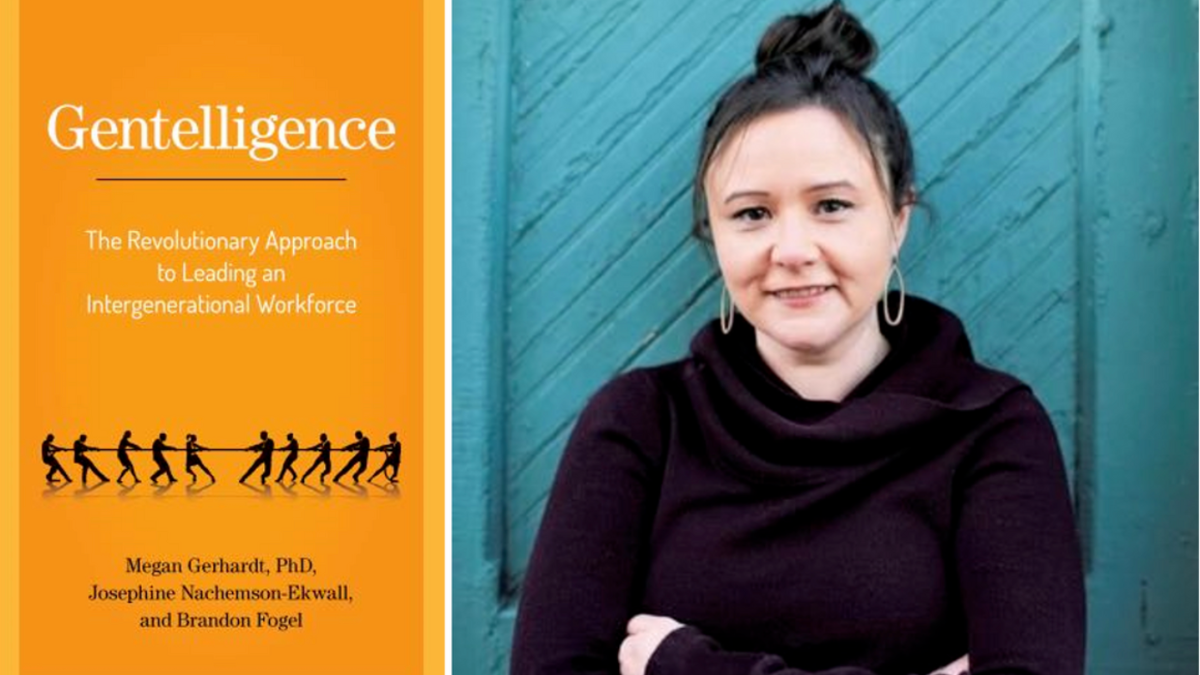
Megan had managed to articulate what I had been observing for years.
Rather than focusing on generational stereotypes or workplace frustrations, she offered something far more useful: a practical framework for understanding and leveraging generational differences.
Her approach rests on four practices:
Challenge Assumptions
Adjust the Lens
Build Trust
Expand the Pie
Simple.
Practical.
Actionable.
Most importantly, it shifted the conversation away from "Which generation is right?" and toward "How can we learn from one another?"
That distinction changes everything.
Over the years, Megan and I have shared many wonderful conversations. I've recommended her book countless times to clients, colleagues, and friends. I've watched with admiration as her work has reached organizations and audiences around the world.
The timing couldn't be better.
Today, leaders are navigating unprecedented demographic shifts. Five generations now work side by side. Knowledge transfer, succession planning, retention, communication, and innovation are all influenced by how effectively people work across age-based differences.
The need for generational intelligence has never been greater.
One conversation with Megan has stayed with me.
Shortly after Gentelligence was published, I asked whether she planned to certify trainers in the methodology.
If so, I wanted in.
Her response surprised me.
"Mary," she said, "I don't think that would be a good fit for you."
Then she explained.
"You are already doing this work. Don't change what you're doing to fit me. Use Gentelligence as a tool within what you're already teaching."
At the time, I experienced those words as both an affirmation and a gift.
I saw the value she was bringing to the field.
She saw the value I was already bringing to it.
The best mentors don't create copies of themselves.
They help others become more fully themselves.
As I look back over the last five years, I realize that one of the greatest gifts Megan gave me wasn't simply a framework.
She gave me confidence.
Confidence that what I had observed in classrooms, boardrooms, workshops, and conversations over the years wasn't imaginary.
It was real.
It mattered.
And it was worth exploring further.
So this week, I'd like to offer a simple thank you.
Thank you, Megan, for your scholarship, leadership, generosity, and friendship.
Thank you for building a framework that has helped thousands of leaders navigate generational differences with greater curiosity and less judgment.
And thank you for helping this Boomer find language for something she had been seeing all along.
Try This
Think about a challenge your team is facing right now.
Do you have a solution to the problem?
Or do you have a language problem?
Sometimes the breakthrough comes not from working harder, but from finding a better lens through which to understand what you're seeing.
More soon,
Mary