
Why Employee Resource Groups Matter More Than You Think
I walked into an ERG Summit this week not quite sure where- or if -I would fit.
I’ve worked with ERGs for years—but this felt like a chance to listen, learn, and understand how the work is evolving.
To see what adjustments I might need to make to stay aligned with what organizations need right now.
What I didn’t expect was to find myself right in the middle of a much bigger conversation.
The Summit—hosted by Exodus Consulting Group and The Unity Collaborative—was centered on a powerful idea:
Sustaining & Scaling Inclusion: Workforce Sustainability as a Competitive Advantage.
From the start, there was a clear call:
We need to move inclusion from intention… to infrastructure.
Not just passion.
Not just programming.
But systems that actually hold.
And alongside that came a very real pressure:
ERGs are being asked to prove their value.
Not just as community spaces—
but as contributors to business outcomes:
Retention.
Engagement.
Innovation.
Even revenue.
In some organizations, ERGs are even being cut—because they’re seen as too closely tied to DEI.
So the question I heard over and over was:
“How do we show impact?”
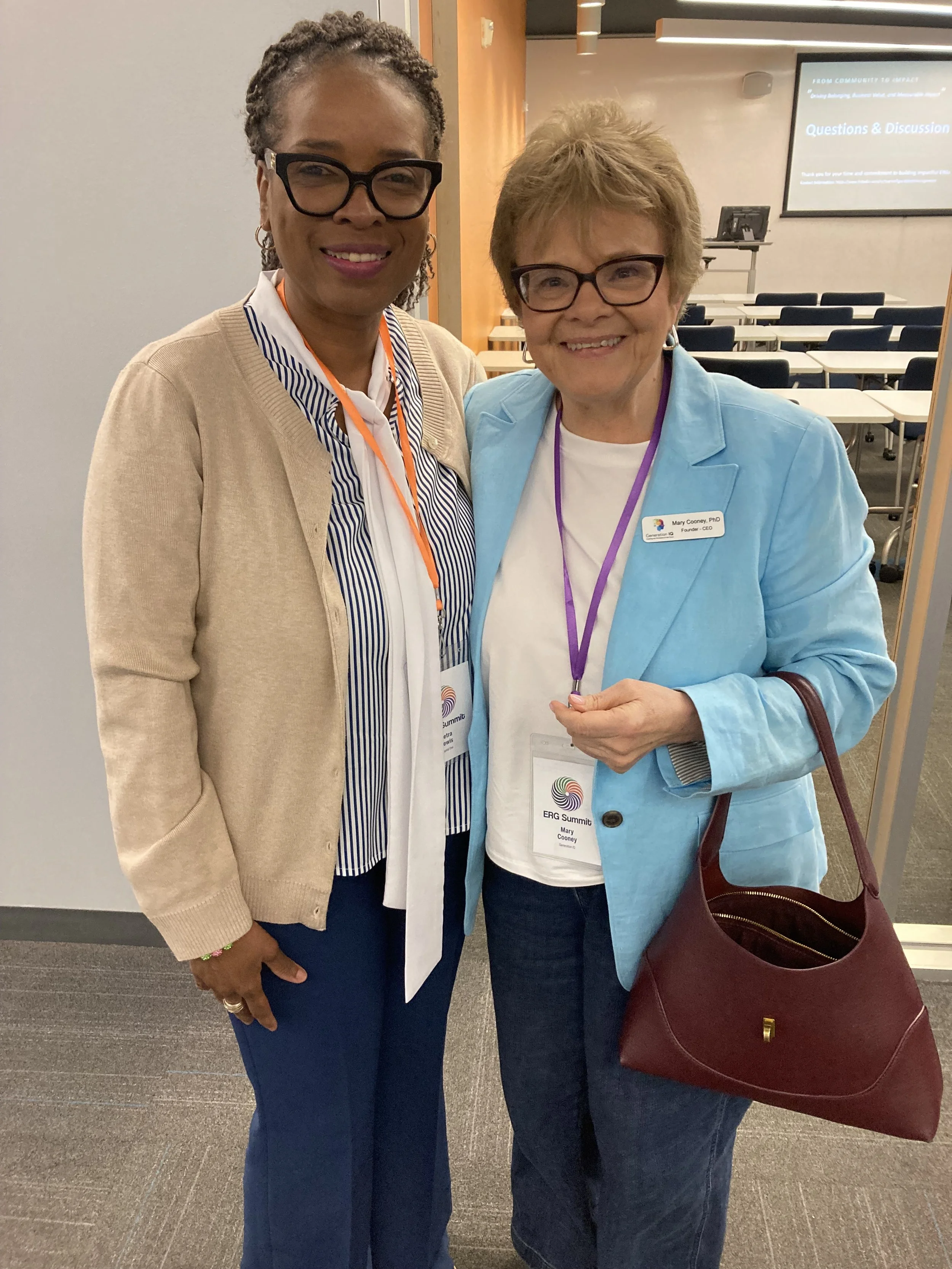
Good to catch up with longtime friend Ketra Lewis
Here’s what struck me.
There was a strong focus on outcomes—
metrics, alignment, ROI.
And that makes sense.
This is where many organizations are right now.
But what felt harder—less defined—was the how.
Not because it isn’t happening.
But because it’s already happening in ways that are harder to name,
harder to measure,
and harder to translate into a business case.
And maybe this is what happens in moments like this—
when systems are shifting, expectations are rising, and the pressure is real.
We can pull back.
We can get cautious.
We can start to second-guess what we’re doing.
Or—
we can get curious.
And what I saw, over and over again that day, was curiosity.
And this is where something unexpected happened for me.
In conversation after conversation, that curiosity started to turn toward something I don’t often hear centered in ERG strategy:
Our generational identity.
Historically, multi-generational ERGs have lived more on the fringes—
sometimes framed as aging initiatives or early career programs.
But rarely do we talk about generational diversity
as one of the most accessible—and powerful—assets inside every ERG.
Because no matter what ERG you’re part of—
groups organized around gender, shared racial and ethnic identities, Pride, veterans, or caregivers—
generational differences are already in the room.
They shape how we communicate.
How we approach work.
How we respond to change.
How we define leadership.
How we build trust.
In one conversation with an LGBTQ+ ERG leader, we talked about how exploring the experience of coming of age in different generations could deepen understanding within the group.
With a Caregivers ERG leader, we talked about why invitations are often declined by those not currently raising children or caring for aging parents.
And the shift was simple:
Even if you’re not in that life stage,
understanding what your colleagues are navigating helps you know
when to step in, when to support, and when to respect a boundary.
And if you’ve already been through it?
Your experience becomes a resource for others.
Which is what makes ERGs focused on aging and life stages so relevant to everyone—
because if all goes well, we will all move through these life stages.
There was even a moment when someone described Gen X as feeling “stuck in the middle”—
trying to reconcile the reality that we can’t lead the way we were led.
And the question became:
How do we support that?
In one moment, I shared a simple idea:
Older generations often bring crystallized intelligence—
experience, pattern recognition, perspective.
Younger generations bring agile intelligence—
adaptability, curiosity, new ways of thinking.
We don’t just benefit from both.
We depend on both.
As the day unfolded, it felt like people were putting on glasses
and seeing something come into focus.
That maybe we don’t have to flatten our differences
or pretend they don’t matter to work well together.
That we can actually use them.
For years, I’ve felt like I was knocking on the door, asking to be part of this conversation.
On Thursday…
I found myself on the dance floor.
I would be remiss not to thank Sandy Harvey and Darlene King-Turner, whose vision brought this event together—with an incredible group of presenters and sponsors who made the day what it was.
I’m still thinking about what’s possible here.
If ERGs are being asked to drive engagement, retention, and innovation—
what role might stronger intergenerational collaboration play in getting us there?
Something tells me the only way we’ll find out…
is to get more people on the dance floor.
Mary