
What Some People Nearing Retirement Won’t Say Out Loud
Organizations want people nearing retirement to pass on what they know before they go. Many hold back. From the outside, it looks like resistance. From the inside, it can sound like this:
Why would I give back now? I haven’t been respected in 40 years. What’s in it for me?
Nobody nearing retirement is going to say that to HR. Some of them are thinking it.
I heard it recently in a breakout room, from someone I’d been told wouldn’t participate. More on that in a minute. First, the question that sent me looking.
At our last roundtable, Courtney asked me a question I’ve been thinking about ever since.
I’m a Boomer, now in my third career. Courtney said that compared with others my age, I’m “on the fringe.” I think she meant that I’m part of my generation but can look at it with some objectivity, and that I can imagine what it’s like for younger people to work with us.
Then she asked: How can people who work with Boomers come alongside us and encourage us to think differently?
I credit theatre for whatever objectivity I have. For someone with my background, stepping into someone else’s shoes is second nature. In my Generation IQ work, I’ve transferred that skill from characters in plays to members of different generations.
When actors step into a character, they ask four questions from that character’s point of view:
1. What do I want?
2. What’s in my way?
3. What tactics can I try to get past it?
4. What’s the bigger goal behind all of it?
Actors call that last one the superobjective. It’s what the character is really after, beyond the problem in front of them.
Let’s start with the person asking Courtney’s question.
What you need
You’re an HR leader or a manager. Someone on your team is a few years from retirement. They hold decades of knowledge: the customers, the history, the judgment calls nobody ever wrote down. And they’re from a generation you may not fully understand.
You need what they know, so the company and its customers are OK after they’ve gone.
They aren’t sharing it.
What’s in the way
I recently worked with a group of credit leaders, most with decades in the business. Before the session, I was told not to expect much from a few of the most seasoned people in the room.
We broke into small groups and asked them to imagine what a colleague nearing retirement might be thinking but would never say out loud. What follows is a composite, not a transcript. But it’s close.
If I hand it all over, what do they need me for?
Honestly, I couldn’t write down what I do if you paid me. I just know.
Every time they say “mentor,” I hear “clean out your desk.”
Then one of the people I’d been told wouldn’t participate leaned in and said the line at the top of this newsletter.
Nobody rushed to respond. Then heads started nodding. They were talking about an imagined colleague. I don’t think that’s all they were talking about.
That’s four obstacles: fear of becoming expendable, not knowing how to put a career into words, mentoring that sounds like an exit, and resentment. The first three are workable. The fourth is the one HR has to reckon with.
Tactics you can try
Start with curiosity. Ask about their experience before you ask for their knowledge. What was it like when they started? What’s changed? What do they wish someone had asked them years ago? You’re not softening them up. You’re finding out who they are.
For fear, make sharing pay off. Show that passing on knowledge raises someone’s value now, not only on the way out. When what they know solves a problem, give them credit in front of others. If there’s a way to stay connected after retirement, say so. If there isn’t, ask whether there should be.
For “I just know,” ask for stories. Don’t ask them to explain their judgment. Ask about a specific decision: a customer, a tough call, a year that went wrong. Then you record it.
For the exit framing, change what you’re asking for. Don’t tie every conversation to a retirement date. Ask for their help with a problem in front of you now. You might ask if there’s anything they’d like to learn, but don’t assume there is. Many people near retirement are tired, and keeping up with everything new is part of why they’re ready to go.
For resentment, start with the truth. This is the hard one. You probably weren’t there when the trust broke, but you inherited it. When someone thinks “What’s in it for me?” they aren’t wondering about the succession plan. They’re wondering whether anything has changed.
You can’t apologize for decisions you didn’t make. You can say, “What happened to you shouldn’t have happened, and I want to understand it.” Then listen, and don’t defend. Give a real answer to their question: time to do it, a lighter workload while they do, their name on what they built. And take what’s offered, even if it’s only part.
For some people, it may be too late. That’s a cost the organization earned. Capture what you can from records and from the colleagues who worked beside them, and don’t punish them for holding back.
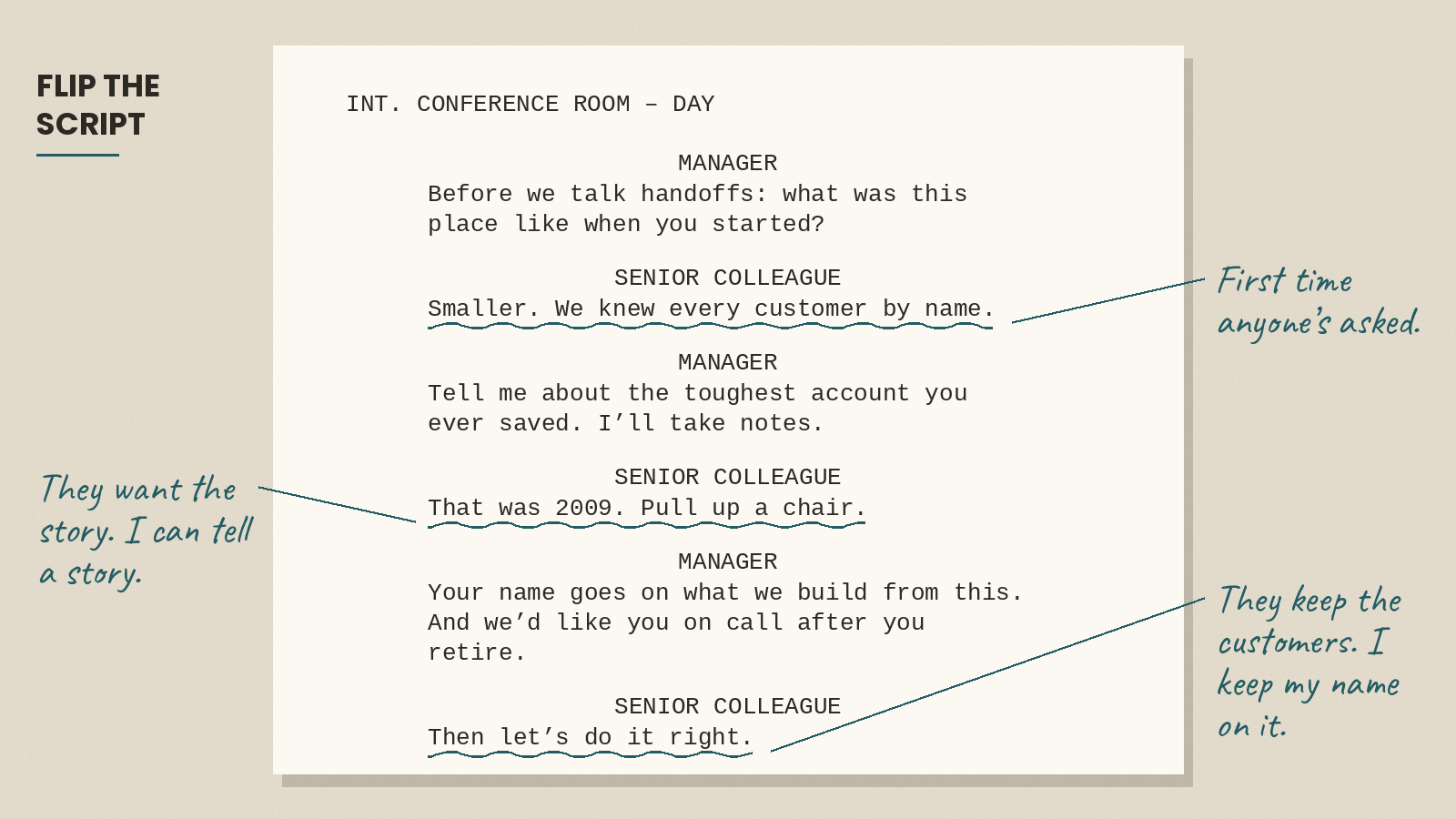
What it looks like when it works
Now meet Jim, Director of Marketing for a transportation company. He’s been there over 30 years, he’s at retirement age, and he’s one of their top producers. The company has told him the timing of his exit is his call.
Jim is using that time to give away everything he knows. His sales team knows what’s happening with his clients: the backstory, the plans, whatever helps them do their jobs. He answers their questions and asks his own. He wants every one of them ready to step into his role.
I asked him why. He started here:
“It’s been an honor to represent this company all these years. They’ve given me room to grow throughout.”
“I intend to finish strong, ensuring they say ‘we’re going to miss Jim’ when I’m gone.”
And then, under a heading he wrote himself, Self-serving benefits:
“My colleagues appreciate my efforts to share, and pay it back by enthusiastically supporting me and projects I’m working on today.”
“By being a committed mentor today, I improve the odds that this company and my colleagues ask me to stay close for a few years after I step away from today’s full-time work.”
That’s Jim’s superobjective, and it’s bigger than solving a problem. The company and its customers keep thriving. He stays relevant. He leaves a legacy. Everyone’s future is richer for what he gave away.
And he didn’t get there on his own. His company spent decades giving him room to grow, so when the time came, he could picture a future worth working toward. The people in that breakout room are his generation. Many of them never got that.
Here’s the bigger why. Your goal only happens if the person nearing retirement has a bigger goal of their own. For people who were never nurtured the way Jim was, the tactics above are how you start. Late, but for many, not too late.
The next 40 years
HR can’t rewrite the last four decades, but it can shape the next ones. The people you hire this year are starting their own 40-year story. That’s where training belongs: teaching frontline managers to notice good work, give credit for it, and ask for input before decisions are made. Trust isn’t repaired at retirement. It’s built or broken every year before it.
Try this
Sit down with someone nearing retirement and ask two questions:
1. How have you been valued here?
2. What would make passing on what you know worth it to you?
Then listen, especially if the answer is hard to hear.
Courtney, thank you for the question. This is a start, not the whole answer. Every organization’s history is different, and so is the repair. If you’re working through this with your own people, I’d welcome that conversation.
Every generation has something to teach and something to learn. Sometimes the person holding back is waiting to be asked, and to be thanked.
More soon,
Mary Cooney, PhD